
Learn to surf in Famara: tips for your first lesson
Learning to surf in Famara is one of those experiences that you will remember long after the trip. Not only because of the waves, but because of the environment, the atmosphere of the village and that feeling of arriving at a wide beach, looking out to sea and thinking: “OK, this is where the adventure begins”.
If you are thinking of trying surfing for the first time, it is normal to have doubts. What to bring, whether you need previous experience, how hard it is to stand up, what board to use at the beginning or whether you need to be in very good physical shape. The good news is that almost anyone can start, as long as they do it with confidence, patience and a good reading of the sea.
For those who want to take their first steps with professional guidance, it is best to start in a surf school in Famara, with instructors who know the area well, the right equipment and classes adapted to the level of each person.
Why this area of Lanzarote is such a good place to learn surfing
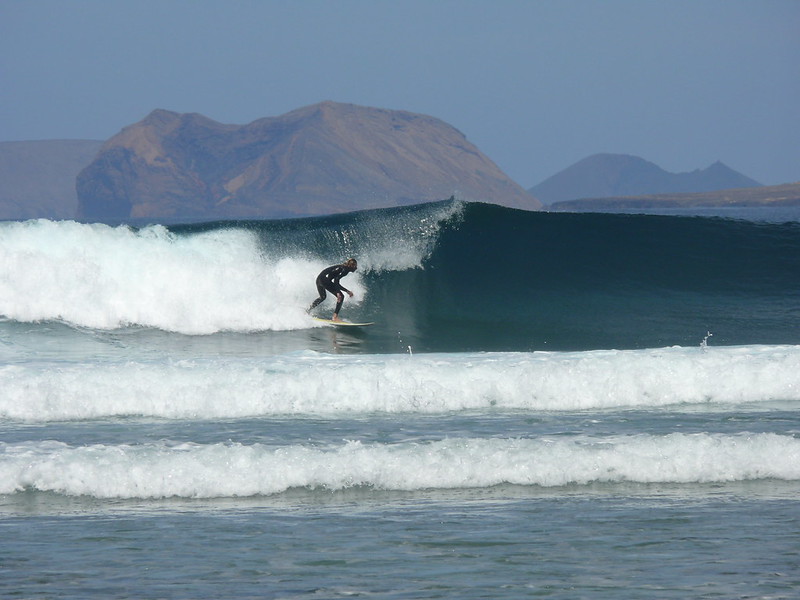
Caleta de Famara beach is one of the best known surfing spots in Lanzarote. Its width, the sandy bottom and the variety of conditions make it a very popular area for beginners as well as for more experienced surfers.
For beginners, one of the most important points is to be able to learn in a large environment, without feeling crowded and with enough space to work on the first manoeuvres. In the first sessions, the aim is not to make perfect turns or catch big waves. The aim is to understand the sea, learn to paddle, get a good position on the board and start to stand up safely.
The scenery also helps a lot. There is something special about surfing with the Risco in the background and the village nearby. It doesn’t magically improve your technique, but it motivates you. And in surfing, motivation counts a lot, because at the beginning you fall a lot. Quite a lot.
What you can expect from your first class
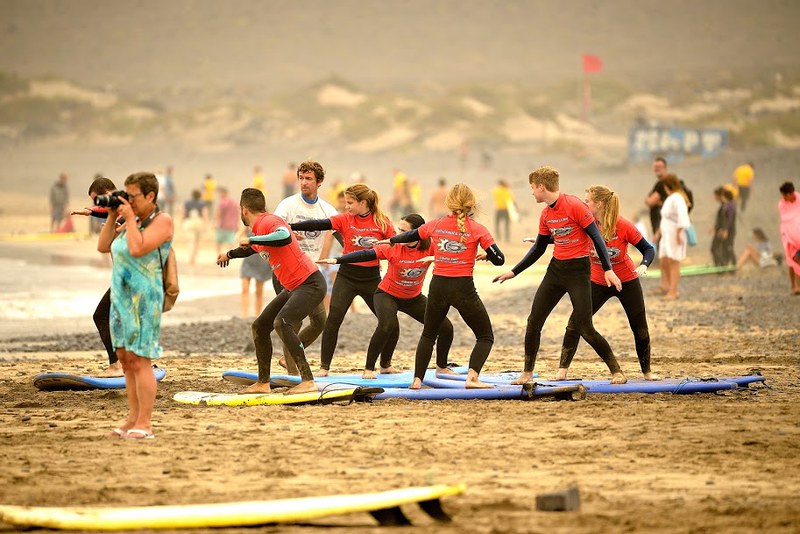
A first surf lesson usually starts out of the water. Before entering the sea, the instructor explains the basic safety rules, how to use the board, how to position yourself, how to paddle and how to do the take-off, which is the movement from lying down to standing up.
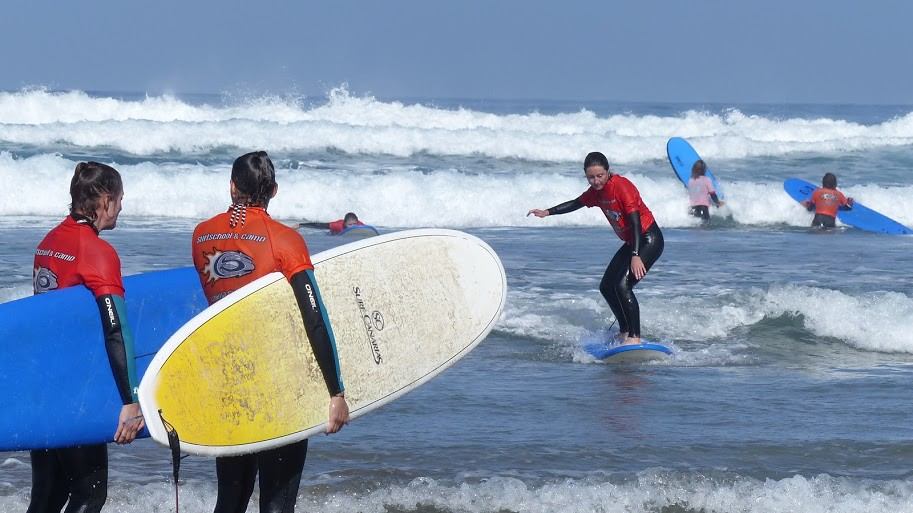
This part on the sand is more important than it seems. Practising in the dry helps the body to understand the movement before facing the waves. Then, in the water, it is usual to start with foam and small waves, always in an area adapted to the level of the group.
You don’t have to stand up on the first wave for the lesson to be a success. Sometimes the first step is to learn to position yourself well, to paddle at the right moment or to lose the fear of falling. Surfing has that humble side, the sea teaches quickly and without too much diplomacy.
Is previous experience necessary?
No. You can start from scratch. In fact, many people who come to a first lesson have never even picked up a board before. The important thing is to know how to swim, listen to the instructor’s instructions and be willing to try something new.
Lessons for beginners are usually designed to do just that: to explain step by step how the basic dynamics of surfing work, what to do in the water and how to progress without rushing. The equipment is also adapted to the level. Normally larger, stable boards with good buoyancy are used, making it easier to paddle and balance.
With the right board and a clear explanation, the experience changes a lot. Trying to learn on your own with the wrong board can turn a first session into a small naval battle. Better to start well.
What to bring to a surf lesson
You don’t need to buy a board or wetsuit for your first lesson. Equipment is usually included, especially when you book with a school. Even so, it’s a good idea to bring a few basics to keep you comfortable before and after the session.
Comfortable swimming costume or bikini
You’ll be wearing it under your wetsuit, so choose something that won’t get in the way and allows you to move freely.
Towel and dry clothes
After getting out of the water, especially if it’s windy, you’ll appreciate having a towel and dry clothes handy.
Sunscreen
On Lanzarote the sun can be deceiving, even on cloudy days. Use waterproof protection and apply it in good time before going in.
Water
Surfing is more tiring than it looks. Between paddling, balance, waves and emotion, the body works hard. Carrying water is always a good idea.
How to choose the practice area
A fundamental part of a good lesson is choosing where to enter the water. Not all areas of the beach are the same and conditions can change depending on the tide, wind and size of the waves.
For beginners, you usually look for areas with controlled foam, sandy bottom and enough space to practice safely. The aim is not to get in where the advanced surfers are, but to find a spot where you can learn progressively.
This reading of the sea is one of the reasons why it is worth starting with local instructors. Knowing how to interpret the conditions of the day avoids scares and makes the lesson much more profitable.
How long does it take to learn to surf?
It depends on the individual. Some people manage to stand up for a few seconds in the first class. Others need several sessions to gain balance and confidence. Both situations are normal.
Surfing is not just about getting up on the board. You also have to learn how to paddle, position yourself, watch the wave, manage your nerves and understand when it’s the right time to try to stand up.
Therefore, if your goal is to make real progress, a course of several days is often better than a single class. Repetition helps a lot. The body starts to remember movements, fear is reduced and each session allows you to correct small mistakes.
Single class or multi-day course
A single lesson is perfect if you want to try surfing for the first time and experience it without compromising several days of your holiday. It allows you to discover what a session is like, familiarise yourself with the board and see if you feel like learning more.
A course lasting several days, on the other hand, is more advisable if you want to notice progress. By repeating sessions, it is easier to improve your paddling, correct your posture and gain confidence in the water. It also helps to better understand how sea conditions change from one day to the next.
For a first experience, one lesson may be enough. If you want to learn with more experience, several days are better. Surfing rewards perseverance, even if at the beginning it also rewards you with some elegant falls.
Tips before your first session
Come with enthusiasm, but don’t demand too much of yourself. Surfing requires patience. Some people get up early and others take longer, but everyone goes through a phase of adaptation.
Always listen to the instructor, respect the safety instructions and don’t compare yourself with those who have been in the water longer. Everyone has their own pace. It is also advisable to rest well before the class and not to eat too much just before entering the sea.
Another important tip is not to become obsessed with standing up. Sometimes the best first lesson is the one where you understand how to move, how to land, how to paddle and how to get more comfortable in the water. The rest comes with practice.
Why learn with local trainers
Learning with someone who knows the beach well makes all the difference. An instructor not only corrects the technique, but also interprets the conditions, chooses the right area and adapts the class to the student’s real level.
On an open beach, factors such as wind, current, tide and wave size have a big influence on the session. That’s why it’s important not to improvise, especially if it’s your first time.
In addition, a guided lesson allows you to progress with a clear methodology. First safety, then position, then paddling, balance and basic wave reading. Going step by step usually gives better results than trying to learn everything at once.
If you are preparing your trip to Lanzarote and want to learn on a wide beach, with a sandy bottom and a surfing atmosphere, you can check out our surf lessons in Famara. You will find options for beginners, intermediate levels, private lessons and multi-day courses.
The most important thing is to start with safety, good equipment and a clear explanation. The rest is provided by the sea: a few waves, a few falls and, hopefully, that first moment when you stand up and understand why so many people get hooked on surfing.
About the author

Maike Famara
Director of Surf Famara. A free surfer from the 1970s, renowned in the Canary Islands, he has surfed on five continents (the entire South African coast, Western Australia, Indonesia, Peru, Chile, Puerto Rico, Panama, France, Portugal, Senegal, Morocco...) and has dedicated himself to teaching and developing new surfers since 1996! You can find him in San Juan or La Santa, where he remains connected to the ocean like the first day.